
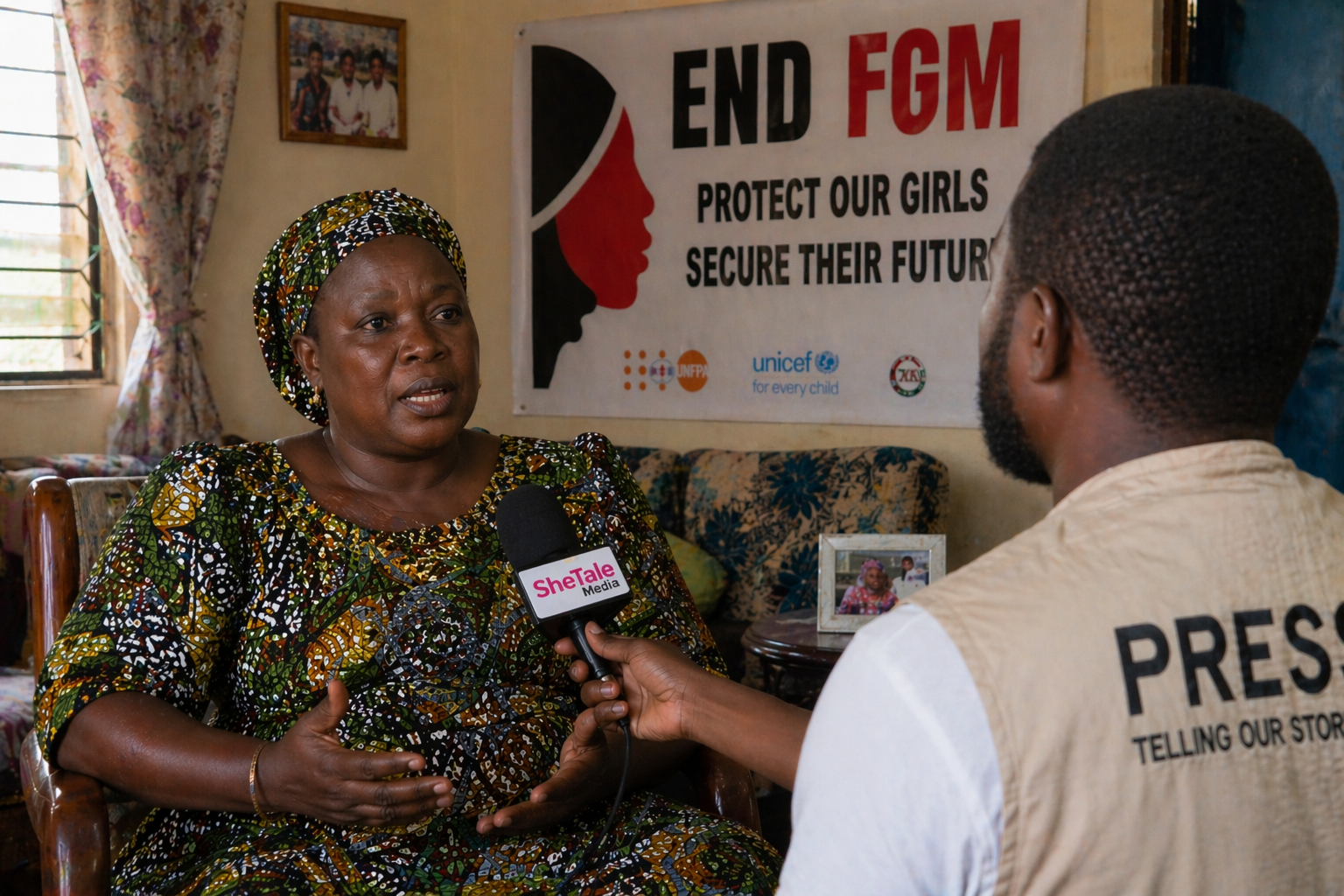
A mother of eight, Manjang carries a story that is both deeply personal and widely shared among women in The Gambia. But unlike many, she has chosen to confront it openly. Sitting in the shade of her family compound, her voice steady but reflective, she speaks not only as a survivor of Female Genital Mutilation (FGM) but as a mother resolved to end its legacy within her own home.
“I still carry the scars of a tradition I never chose,” she says quietly. “For years, I believed the lie that my daughter’s safety depended on a blade—until I looked into her eyes and realised that true protection isn’t found in a ritual, but in the courage to break the cycle.”
Manjang was thirteen when she was taken to her grandmother’s farm under the promise of a visit and a gift. What followed is a memory she cannot forget. There was no warning, no consent—only reassurance wrapped in tradition. She recalls being told the procedure would make her “clean” and worthy of respect.
“I was happy when I arrived,” she remembers. “My grandmother treated me with love. I didn’t know what was coming.”
The next day, a stranger arrived. What was described as a rite of passage quickly became a moment of irreversible change. Manjang was circumcised and, as she later learned, subjected to what is commonly referred to as “sealing.”
Sealing—medically known as infibulation—is the most severe form of FGM. It involves narrowing or closing the vaginal opening, often by cutting and repositioning the external genital tissue, sometimes leaving only a small opening for urine and menstrual flow. According to the World Health Organisation, this practice carries serious and lifelong health risks, including severe pain, infections, difficulty urinating, complications during menstruation, and life-threatening risks during childbirth. It can also lead to long-term psychological trauma and sexual health complications.
For years, Manjang lived with the consequences without fully understanding them. It was only after her marriage that the reality of what had been done to her became undeniable. She was told she would need to undergo another procedure to “open” her body for intimacy—a process known as deinfibulation.
“I was confused and angry,” she says. “But there was nothing I could do. I had to endure it.”
She describes that second experience as traumatic—one that compounded the pain rather than healed it. Today, she speaks candidly about the lasting impact on her body and her sense of self.
“From that day to this, I still feel pain,” she says. “Intimacy is not something I enjoy. It feels like an obligation, not a connection.”
Yet, amid that pain, something shifted. For Manjang, motherhood became a turning point—a reason to question what had once seemed unquestionable. Watching her daughters grow, she began to see the possibility of a different future.
“As long as I am alive, my children will never go through what I went through,” she says firmly.
Her decision, however, is not without fear. In a society where tradition remains deeply rooted, resistance can come at a cost. She worries about what might happen if she is no longer there to protect her daughters. The pressure from extended family and community expectations is real and persistent.
Still, she remains resolute.
Choosing not to continue the practice is, for Manjang, an act of quiet rebellion—one that does not seek confrontation but demands change. It is a decision grounded in lived experience, not theory; in pain remembered, not abstract debate.
By sharing her story, she hopes to do more than protect her own children. She hopes to spark reflection in others—especially mothers who, like her, once believed they had no choice.
“I want my daughters to grow up whole,” she says. “To live without fear, without pain, and without silence.”
In Gunjur, where conversations around FGM are often whispered, voices like Manjang’s are slowly reshaping the narrative—not through force, but through truth.
This story is part of the "Breaking the Silence: Voices of FGM Survivors" podcast funded by the Foundation for Women's Health, Research and Development (FORWARD UK).
Author: Nelson Manneh
PC: AI-Generated
Comments (0)
No comments yet. Be the first to comment!