
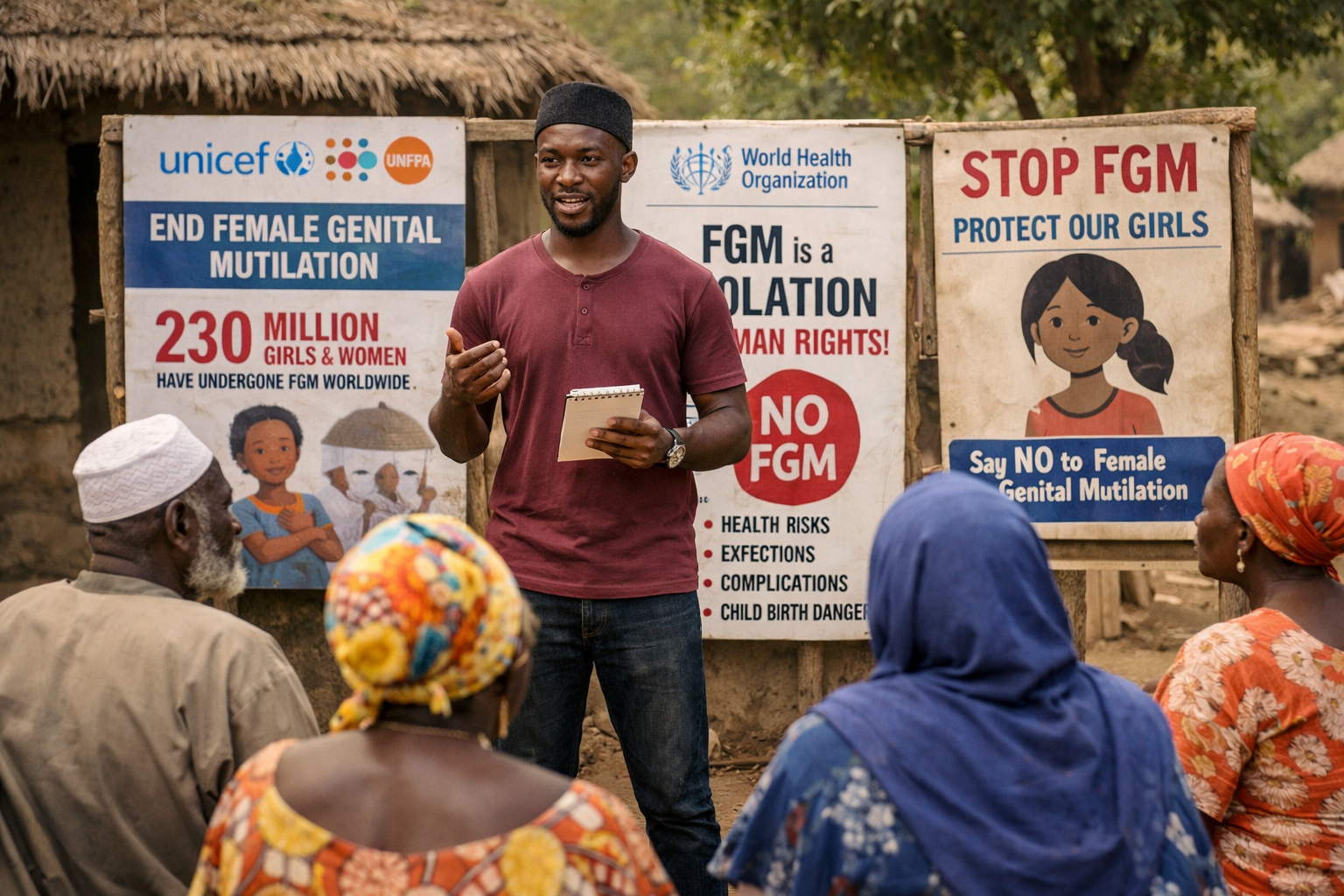
Speaking in his home in April 2026, Bah said, “As a child, I witnessed my own sisters being cut and hidden in our home by my grandmother. While I was too young to act then, I now pledge that if I see anyone—even my own mother—carrying out or supporting this practice, I will report them to the authorities.”
His stance reflects urgent global concerns highlighted by organisations such as UNICEF, UNFPA, and the World Health Organisation. According to these agencies, more than 230 million girls and women alive today have undergone FGM worldwide, with millions more at risk each year—particularly in parts of Africa, including The Gambia.
In The Gambia specifically, national data supported by UNICEF indicates that around 73% of women aged 15–49 have experienced FGM, underscoring how widespread the practice remains despite legal prohibitions.
In Kombo South, Bah and other youth activists are working alongside community leaders to challenge these realities through grassroots education and advocacy. Their efforts mirror joint UNFPA-UNICEF programmes that emphasise community dialogue and youth engagement as critical tools for ending FGM.
Bah noted that youth groups are facilitating intergenerational conversations to dismantle the misconception that FGM is a religious obligation, often involving imams who clarify that Islam does not require the practice.
Reflecting on his childhood, Bah recalled being removed from the room he shared with his sisters at the age of ten—the day they were taken to be cut.
“I remember asking my grandmother about it. She told me it was ‘purification’ and that cutting was necessary for maturity and cleanliness,” he said.
Medical evidence from the World Health Organisation directly contradicts such beliefs. WHO warns that FGM has no health benefits and instead leads to severe short- and long-term consequences, including infections, complications in childbirth, and increased risk of newborn deaths. The practice is internationally recognised as a violation of human rights.
Bah described how circumcision was once a celebrated seasonal event in Gunjur. “It was a major ceremony. If the season came and you didn’t have a child to be cut, you felt excluded. But if you had children to bring, you felt a sense of pride.”
Despite this cultural pressure, change is slowly emerging. According to UNICEF and UNFPA data, younger generations in several countries, including The Gambia, are showing declining support for FGM, signalling a potential shift in social norms.
However, Bah warned that communities like Gunjur and surrounding Mandinka-dominated areas remain highly vulnerable. “Many people tie FGM to religion and culture, feeling an obligation to continue it,” he explained. “I remember my mother telling us that an uncircumcised girl was ‘unclean.’ Often, they would not only circumcise the girls but seal them as well.”
Through his pledge, Bah joins a growing movement of young people determined to challenge harmful traditions with facts, human rights awareness, and courage—one case at a time.
This story is part of the "Breaking the Silence: Voices of FGM Survivors" podcast funded by the Foundation for Women's Health, Research and Development (FORWARD UK).
Author: Nelson Manneh
Comments (0)
No comments yet. Be the first to comment!