
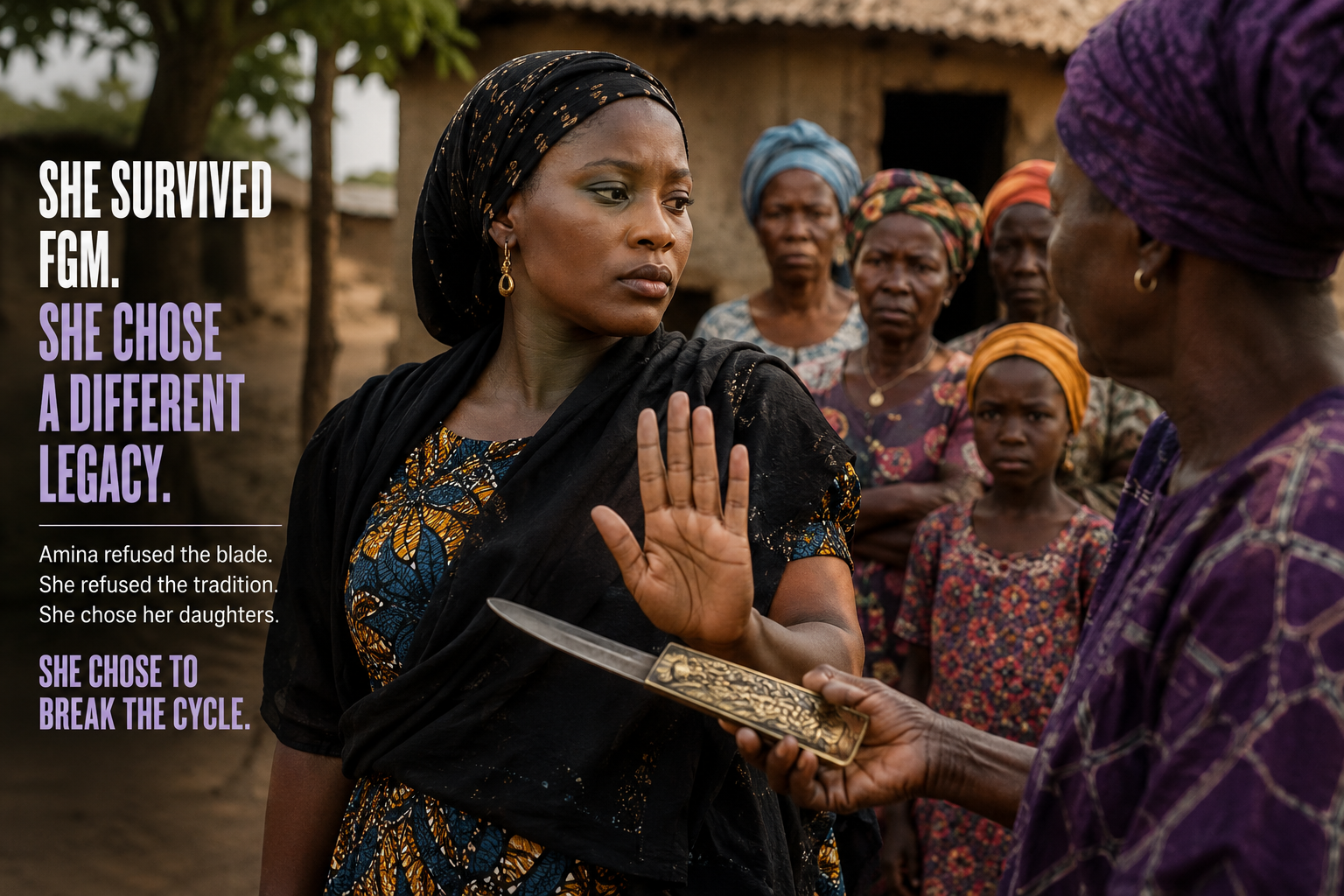
This was no ordinary blade. It carried the history of generations of women in Amina Camara's family—her grandmother had used it to perform circumcisions on hundreds of girls, and later, her mother continued the practice.
Now that her mother was growing old, the family expected Amina, as the firstborn daughter, to take her place. However, Amina had already endured the pain of female genital mutilation (FGM) herself.
Speaking to this medium in August, 2026, Amina understood what it meant to be a girl subjected to a practice that her family regarded as tradition, honour, and a responsibility to uphold.
Amina knew she could not become the person who would pass that experience on to another child. When the moment came for her to inherit the practice, Amina did something that challenged generations of family expectations: she said no.
“That day was the saddest day of my life,” she recalled. “All my siblings and other relatives gathered to convince me to inherit the blade.”
Her relatives reminded her of the family's expectations, insisting that the firstborn female must inherit the practice once her mother became too old to continue. But Amina stood firm; she would not take the blade.
“I didn’t forbid them from continuing the practice, but I told them plainly that I could not and would not be a circumciser,” she said.
Her refusal was not driven by fear of punishment or pressure from outside the family. It stemmed from something much closer to home: her own experience as a survivor of FGM and her growing understanding of the harm associated with the practice.
Amina, a native of Brikama Manduar, in the West Coast Region of the Gambia, had been circumcised by her mother when she was very young. As she grew older, she watched her mother prepare to pass the practice on to her. Her mother repeatedly encouraged her to stay close and observe how she performed circumcisions, but Amina resisted.
“My mother told me that whether I liked it or not, I had to inherit the practice because it must not die,” she said.
Her mother also claimed that being a circumciser brought honour, financial rewards, and even eternal rewards. But Amina could not reconcile those promises with what she had witnessed.
“I always refused to go near her whenever she was cutting. I told her I couldn't bear to see the blood,” she reflected. That memory stayed with her.
When her mother died, the pressure didn’t go away. Instead, relatives gathered once more, urging Amina to take on the role they believed was meant for her.
This time, however, Amina had made her decision. Her education had given her a deeper understanding of Female Genital Mutilation (FGM) that challenged the beliefs she had inherited. She realised that what had been presented to her family as a tradition could also cause significant harm.
"I did not refuse to continue the practice because I was afraid of the law," she said. "I chose not to because I am aware of the harm it causes." Her conclusion was clear: "FGM causes far more harm than good. It is a harmful traditional practice that should be abolished."
Amina's decision became even more personal when she became a mother. She has four daughters, and none of them has undergone FGM.
"I told my husband that none of our children would go through it," she explained, and he agreed after she outlined the risks associated with the practice.
Amina had been protecting her daughters even before her mother passed away. She recalled taking them to school and returning to pick them up right after classes ended because she was uncomfortable leaving them alone with her mother.
The fear was not just theoretical; Amina knew the tradition her mother had followed and what could happen if her daughters were left vulnerable to the same expectations.
Her experience as a survivor transformed her view of motherhood. While she couldn’t change what happened to her as a child, she could control what would happen to her daughters.
Amina’s refusal to continue the practice came with consequences.
Today, she asserts that no one in her community has inherited the practice. Some people resent her decision because families wanting their daughters circumcised now have to travel elsewhere.
They had expected Amina to continue the service her mother and grandmother had provided for generations.
However, she refuses to take on the responsibility for another girl's suffering. Her decision effectively interrupted a chain that had linked three generations of women in her family. The expectation was simple: grandmother to mother, mother to daughter. Amina chose to stop it with her. She did not inherit the blade.
Amina's story is much more than simply refusing to become a circumciser; it is about how a survivor uses her own experiences. Once, Amina was a child who endured female genital mutilation (FGM).
Later, she was the daughter expected to continue this practice.
Eventually, she became a mother facing the critical decision of whether to subject her own daughters to it. She chose differently.
The same family history that could have made her just another link in the chain of tradition became the reason she decided to break it.
Her grandmother had left behind a blade, and her mother was expected to pass it to her. Instead, Amina chose to leave behind a different legacy for her daughters: a future free from FGM.
By rejecting the blade, she did more than refuse a family obligation; she broke a painful legacy.
This story is part of the "Breaking the Silence: Voices of FGM Survivors" podcast funded by the Foundation for Women's Health, Research and Development (FORWARD UK).
Author: Nelson Manneh
PC: AI-Generated
Comments (1)