
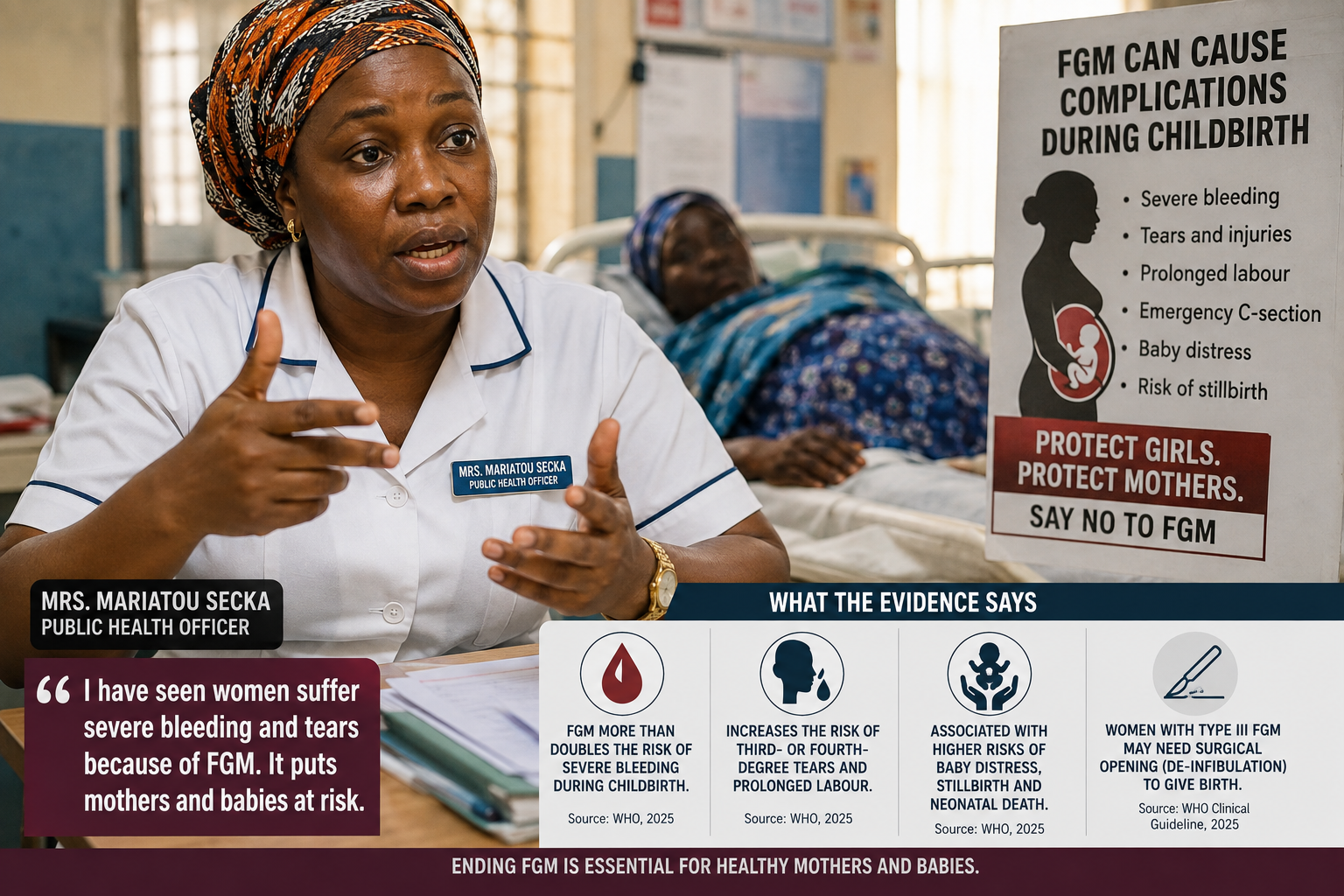
Mariatou Secka, a public health officer who began her career as a midwife, has witnessed these experiences firsthand. After years of working in maternity wards, she has encountered women whose childbirth experiences were complicated by FGM. "I have come across many cases of individuals who faced severe challenges because they are FGM survivors," Secka stated in an interview in August 2026.
"Most of them have to endure significant tearing just to save the lives of their unborn babies."
The World Health Organisation (WHO) associates FGM with prolonged or obstructed labour, postpartum haemorrhage, perineal tears, instrumental deliveries, and cesarean sections. A 2025 WHO review of over 75 studies from approximately 30 countries found that women who had undergone FGM were more than twice as likely to experience prolonged or obstructed labour or haemorrhage compared to women who had not undergone FGM. For Secka, these findings are not just statistics; they represent the women she has encountered in the maternity ward.
Three Days Waiting to Give Birth
One case she recalls occurred in 2020 while she was working at Serekunda General Hospital. A pregnant woman was admitted expecting to give birth, but hours turned into days. Secka remembers that the woman spent approximately three days in the hospital without delivering her baby. Doctors eventually considered performing an episiotomy—a surgical incision made to widen the vaginal opening when medically necessary.
However, there was another concern: the woman had undergone FGM. Secka recalls asking the doctor why there was a need for caution. He explained that because the woman was an FGM survivor, the procedure carried an increased risk of cutting rigid tissues, which could lead to uncontrollable bleeding. This case illustrates how the effects of FGM can manifest years after the initial procedure.
Healing may leave scar tissue, and the extent of complications can vary depending on the type of FGM, the degree of scarring, and the circumstances of labour. The risks are particularly significant for women who have experienced Type III FGM, also known as infibulation, which narrows the vaginal opening. In such cases, healthcare providers may need to perform de-infibulation to open the scar tissue and facilitate childbirth.
The Evidence Behind the Stories
Evidence from The Gambia suggests that the experiences described by health workers are not isolated. A multicenter study involving 1,569 women across four healthcare facilities in The Gambia found that approximately 77% had undergone FGM. Researchers found that postpartum haemorrhage was more common among women who had experienced FGM, with the risk increasing according to the severity of the procedure.
The study also found associations between FGM and cesarean deliveries, perineal tears, newborn resuscitation, and perinatal death. These findings are significant in a country where UNICEF estimates that 73% of women aged 15 to 49 have undergone FGM.
Data from the 2019–2020 Gambia Demographic and Health Survey also indicate that around 65% of women who underwent FGM were cut before the age of five. For many survivors, therefore, the procedure took place before they were old enough to understand its potential consequences or make informed decisions about their own bodies.
When a Mother’s Struggle Affects Her Baby
The challenges faced by an FGM survivor during labour can sometimes impact the newborn as well. The WHO identifies increased risks of newborn resuscitation, stillbirth, and early neonatal death among women who have undergone FGM. Secka recalls a troubling case from 2021 at Serekunda General Hospital involving an FGM survivor whose baby died following complications during delivery.
The experience can be distressing, but it is crucial not to claim that female genital mutilation (FGM) is solely responsible for complications. Difficult births and newborn deaths can arise from multiple factors, and a single clinical case cannot establish direct causation. However, broader research indicates that FGM can increase the likelihood of complications that may put newborns at greater risk.
The Invisible Wounds
The impact of FGM extends beyond the physical body. For some survivors, pregnancy, medical examinations, and childbirth can evoke traumatic memories. The World Health Organisation (WHO) identifies anxiety, depression, and post-traumatic stress disorder as mental health consequences associated with FGM. Secka notes that some survivors experience intense fear surrounding medical examinations and childbirth.
For a woman who underwent FGM as a child, the maternity ward can represent two conflicting experiences: the anticipation of becoming a mother and the memory of a traumatic event she had no power to prevent. This underscores the necessity for survivor-centred healthcare. Women living with FGM need healthcare providers who understand their experiences, communicate respectfully, and uphold their dignity. They should not be treated merely as statistics or reduced to clinical cases.
Preparing for Safer Childbirth
The evidence does not suggest that women living with FGM should approach childbirth with fear. Instead, it emphasises the importance of preparedness. Early antenatal care allows women to discuss their FGM status with healthcare providers and identify potential complications before labour begins.
Healthcare workers also need appropriate training to recognise FGM-related complications and, where necessary, provide or arrange for de-infibulation. WHO clinical guidance recommends interventions for women living with FGM, including de-infibulation for those with Type III FGM, as well as mental health support for survivors experiencing psychological difficulties. For Secka, proper preparation can mean the difference between an anticipated complication and a medical crisis.
However, the long-term solution is to prevent girls from undergoing FGM in the first place.
The Survivor Behind the Statistic
One of the most challenging aspects of FGM is that its effects may not always be immediately visible. A girl may undergo the procedure, recover from the initial injury, and grow into adulthood without experiencing an obvious medical crisis. Years later, she may face challenges related to menstruation, sexual activity, pregnancy, or childbirth. The absence of immediate complications does not prove that FGM is harmless.
The World Health Organisation (WHO) states that female genital mutilation (FGM) has no health benefits and can lead to both immediate and long-term health consequences. It is estimated that over 230 million girls and women worldwide are living with the effects of FGM.
In The Gambia, FGM is not just a statistic; it is a reality faced by women and girls in their homes, communities, and healthcare facilities.
Behind every percentage is a person, and behind every medical case is a survivor.
Secka's experiences serve as a reminder that women who have undergone FGM should not be defined by it. They are women, mothers, daughters, and community members whose stories deserve dignity, compassion, and understanding. Preventing FGM means protecting girls before they become survivors.
However, for those who are already living with its consequences, it is our responsibility to ensure that their voices are heard, they are respected, and they receive compassionate, survivor-centred care.
This story is part of the "Breaking the Silence: Voices of FGM Survivors" podcast funded by the Foundation for Women's Health, Research and Development (FORWARD UK).
Author: Nelson Manneh
PC: AI-Generated
Comments (0)
No comments yet. Be the first to comment!