
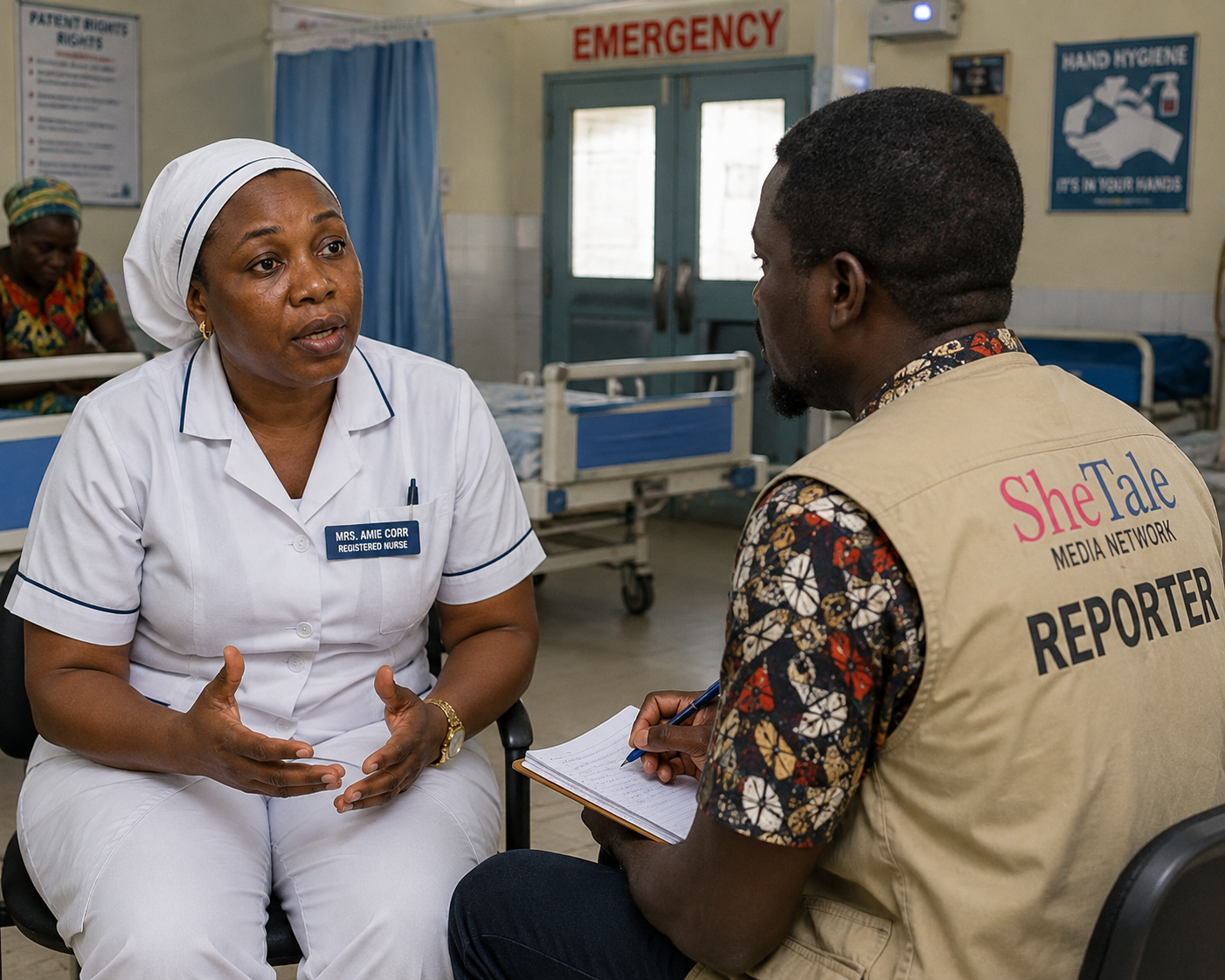
Speaking to this medium in August, 2026, she said, “When the mother arrived holding the child, the nurses were reluctant to help her,” Corr recalled. “I walked toward the woman. She screamed and told me her child was dying.” Corr asked what had happened, and the answer was devastating. “She responded that her mother had circumcised the child, and the child had been bleeding ever since.”
Corr had encountered FGM survivors before, but some cases stay with health workers in ways that do not end when a patient leaves the hospital. She remembers looking at the child and feeling her heart sink.
“I took the child inside and did everything I could until the bleeding finally stopped,” she said. After that, she called a doctor to examine the girl.
The child was admitted and remained in the hospital until the following day, when they were discharged. The immediate emergency was over. But for Corr, the memory was not.
The Child Behind the Clinical Case
In medical records, the incident might eventually be reduced to a diagnosis, treatment, and discharge. For the nurse who treated the girl, however, it was a child in pain. Corr states that one of the hardest parts of working with FGM survivors is that the clinical language used to describe complications can sometimes obscure the human suffering behind them.
A child may arrive at a hospital with bleeding, infection, or another injury. A healthcare worker must prioritise stopping the bleeding, treating the wound, and stabilising the patient. However, there is also the image of a frightened child and a mother carrying her, along with the knowledge that the injury was not caused by an accident or illness but rather by a procedure performed deliberately on the child’s body. “You always remember the pain that the victims went through,” Corr said.
“It resonates in your mind as if you or someone close to you experienced it firsthand.” For Corr, this aspect of the work can be difficult to set aside at the end of a shift. When saving a child is only the first step, the case also posed another challenging question for Corr and her colleagues: Should the incident be reported to the police?
Corr initially felt that reporting what had occurred was necessary to take legal action.
The Gambia has prohibited female genital mutilation (FGM) since the passage of the Women's (Amendment) Act in 2015, which criminalises the practice and imposes penalties on those who aid or promote it. However, the reality that Corr faced was not a legal textbook but a mother standing in a hospital with her injured child. Her colleagues advised caution, fearing that reporting the case immediately might create additional challenges for a family already dealing with significant trauma.
“We all understood that it was a harmful act and punishable by law,” Corr explained. “But seeing the trauma and the condition of the woman, we recognised that this might not be the best approach at that moment.”
This decision left Corr with a dilemma that extends far beyond a single hospital room. Healthcare workers are expected to protect patients, provide compassionate care, and, when necessary, respond to suspected abuse and violations of the law. However, when a child arrives injured after FGM, the immediate priority is often straightforward: stop the bleeding and save the child. The questions of accountability, reporting, family dynamics, and prevention come later.
The Invisible Injuries of FGM
Female Genital Mutilation (FGM) can lead to severe bleeding, infections, urinary problems, and other immediate complications. Its effects can persist into adulthood, impacting menstruation, sexual health, childbirth, and psychological well-being. The World Health Organization emphasizes that FGM offers no health benefits and can cause both short- and long-term complications. However, the damage caused by FGM is not always reflected on medical charts.
There are deeper issues at play: - Fear - Trauma - The unsettling possibility that a child who should see adults as safe figures may instead associate them with pain.
Healthcare workers are often required to witness the consequences of FGM repeatedly.
Corr describes this emotional burden as something that lingers long after they leave the hospital.
"Professionals often struggle with feelings of institutional helplessness and the challenge of providing trauma-informed care for both immediate injuries and long-term gynaecological issues," she notes.
For a nurse, addressing the physical injury is only part of their responsibility. A child may need reassurance, a mother may require support, and the healthcare worker must cope with the emotional weight of what they have witnessed while preparing to treat the next patient.
‘They Still Do It Secretly’
Corr recalls that the case she remembers from Farafenni was not an isolated incident. Throughout her career, she has encountered numerous situations where FGM was performed in secret, and families only sought medical assistance after complications arose. This pattern creates a challenging paradox: While hospitals can treat some of the consequences of FGM, they cannot prevent the procedure from occurring in the first place.
A healthcare worker can stop a child's bleeding, a doctor can treat an infection, and a surgical team can manage complications during childbirth years later. However, none of these interventions can restore the body to its original state before the cutting. This is why Corr believes that the response to FGM must go beyond hospital walls.
The Burden on Healthcare Professionals
The terms "victim" or "survivor" often draw attention to those who have undergone FGM. However, Corr urges people to consider the professionals who frequently encounter its consequences. She does not view herself as a victim of what happened to the child she treated; the suffering belongs to the girl. Nonetheless, Corr acknowledges that witnessing such suffering can impact healthcare workers emotionally.
"The memories can be difficult to shake off," she shares. "You always remember the pain the victims went through."
This emotional burden can be particularly overwhelming when healthcare workers feel they are addressing consequences that could have been prevented. They can stop the bleeding but cannot undo the cutting. They can comfort a frightened child but cannot erase the memory of trauma. They can educate families but cannot change every decision made outside the hospital. They can save a life while still questioning whether more could have been done to prevent the child from ever arriving at their door.
The responsibility does not belong to nurses alone
Corr believes that ending female genital mutilation (FGM) cannot be the sole responsibility of healthcare workers.
“There is still so much to do if we want to eradicate FGM as a country,” she stated. “The authorities, health workers, and advocates all have crucial roles to play.”
She calls for a broader response that includes prevention, education, community engagement, healthcare, and child protection. This means parents need accurate information about the medical consequences of FGM, and communities require spaces to discuss deeply held beliefs about tradition, womanhood, marriage, and identity without silencing survivors. Healthcare workers must receive training to identify and manage FGM-related complications while providing sensitive, survivor-centred care.
Additionally, children need protection from a practice they are too young to understand or consent to. Years later, Corr recalls the incident not just as a case of FGM but as a moment involving a mother. She remembers a mother who walked into the hospital, terrified that her child might die. She remembers the child who was bleeding and the urgency to save her.
And she recalls the difficult questions that followed:
What should happen to the person who performed the cutting?
Should the family be reported?
How should the law be applied?
And how can similar harm be prevented for other children?
These questions remain part of The Gambia's broader struggle with FGM. The country has laws against the practice, but laws alone cannot erase traditions passed down through generations. Corr argues that the response must extend into homes and communities before a child ever reaches an emergency ward. By the time a nurse is holding a bleeding child in her arms, the most crucial opportunity to prevent the harm has already been lost.
For Corr, that is perhaps the hardest memory of all. She was able to stop the bleeding and help the child survive, but she could not prevent what had already happened. This is why, after 20 years in healthcare, she still remembers the little girl who arrived at the hospital in her mother’s arms.
This story is part of the "Breaking the Silence: Voices of FGM Survivors" podcast funded by the Foundation for Women's Health, Research and Development (FORWARD UK).
Author: Nelson Manneh
PC: AI-Generated
Comments (0)
No comments yet. Be the first to comment!