
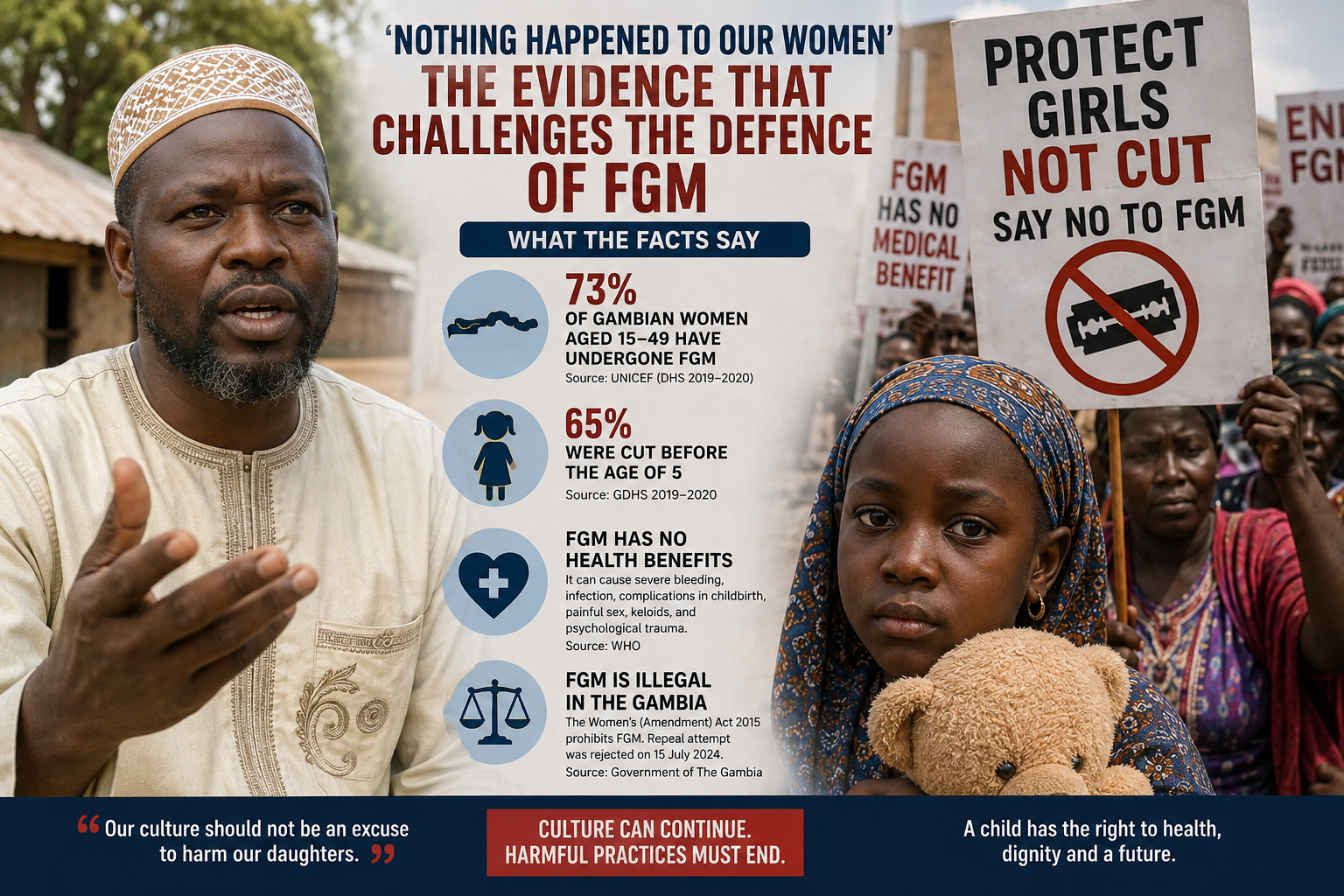
"I was born and raised in a Mandinka community; FGM is still practised there as a cultural obligation, and nothing has happened to our women," Bayo stated.
In August 2026, Bayo shared that five of his sisters had undergone FGM and are now married with children. Because he has never heard them complain about complications, he views the practice as harmless. However, personal experience cannot determine medical safety.
The World Health Organisation (WHO) asserts that FGM has no health benefits and can result in immediate and long-term complications, including severe bleeding, infections, urinary problems, painful menstruation, cysts, keloid scarring, sexual difficulties, psychological distress, and complications during childbirth.
Bayo mentioned that last year, two of his daughters were taken to their grandmother's village during the school holiday and underwent FGM. "After two weeks, they were fine," he said, adding that he intends for his three-year-old daughter to undergo the procedure as well.
Yet a child's seemingly quick recovery from the immediate wounds does not mean she has avoided harm. Some complications can arise years or even decades later, particularly during menstruation, sexual activity, or childbirth.
This raises a fundamental question: Can the absence of visible or immediately reported complications be used to prove that FGM is safe?
Bayo argues that FGM is a cultural requirement for girls, insisting that a woman must be considered "clean."
"I maintain that for a woman to be clean, she needs to be cut," he stated.
However, medical evidence does not support this belief.
The WHO states that FGM has no health benefits and identifies beliefs about cleanliness and the aesthetics of female genitalia as misconceptions that help perpetuate the practice. The argument that FGM is merely a cultural choice neglects the social pressures surrounding it. The WHO and the United Nations Population Fund (UNFPA) identify factors such as social conformity, fear of rejection, marriage expectations, and the desire for community acceptance as forces that can encourage families to continue the practice.
For many girls, therefore, what appears to be a family decision may actually be shaped by powerful expectations about belonging, marriage, and respectability.
Silence Does Not Equate to Safety
Bayo claims he has never met a woman who has reported suffering health problems due to female genital mutilation (FGM). However, the absence of complaints should not be considered evidence that no harm exists. FGM can be enveloped in stigma and silence, which complicates survivors’ willingness to discuss their experiences openly. Some complications related to FGM may not manifest until later in life. Research has linked FGM to various sexual difficulties, including pain during intercourse and reduced sexual satisfaction.
These issues are often kept private, especially in communities where discussing sexuality and reproductive health is taboo. Therefore, it is crucial to understand that not hearing about harm does not prove that harm hasn't occurred.
FGM Does Not Prevent Prostitution
One of Bayo’s major assertions is that women who have not undergone FGM are more likely to engage in prostitution. He mentions that during his travels across Africa, he observed a tendency for women in countries without FGM to be more prone to prostitution. However, he fails to provide evidence demonstrating a causal relationship between FGM and prostitution. Sex work and transactional sex are influenced by a complex array of factors, including poverty, economic opportunities, gender inequality, exploitation, and social circumstances. There is no credible evidence to suggest that performing FGM on girls prevents prostitution, preserves morality, or guarantees marital fidelity.
Tradition Does Not Make a Harmful Practice Harmless
Bayo’s argument highlights an undeniable reality: FGM is deeply rooted in tradition, identity, and community belonging in certain Gambian communities. However, the passage of time does not inherently make a harmful practice safe. Communities can preserve their cultural identity through language, dress, storytelling, initiation rites, family values, and communal celebrations without the need to cut or injure a child’s healthy genital tissue. Thus, the challenge lies not in dismissing culture but in distinguishing between traditions that uplift communities and practices that cause preventable harm.
Who Decides for a Three-Year-Old
Bayo believes that families should be allowed to decide whether their daughters should undergo FGM. However, most victims are children, raising crucial questions about consent. A three-year-old cannot fully understand the procedure, assess its lifelong consequences, or give informed consent to an irreversible alteration of her body.
The World Health Organisation considers FGM both a health and child rights issue, noting that it violates children's rights to health, physical integrity, and protection from cruel, inhuman, or degrading treatment. Therefore, the issue extends beyond parental support; it concerns whether a parent should have the authority to permanently alter a child’s healthy body for non-medical reasons when there is substantial evidence that the procedure offers no health benefits and comes with risks.
The Law Remains in Effect
Bayo has also called for the repeal of The Gambia’s FGM ban. However, the Women’s (Amendment) Act of 2015 prohibits FGM, including performing, procuring, aiding, or abetting the practice. In 2024, the National Assembly considered a bill to repeal the ban but ultimately rejected it on July 15, leaving the prohibition intact. The United Nations and other international agencies welcomed this decision, warning that a repeal could weaken protections for women and girls. Nonetheless, legislation alone will not eliminate FGM.
A comprehensive approach is needed, including education, community dialogue, survivor-centred medical and psychosocial services, and the involvement of parents, traditional and religious leaders, healthcare professionals, women’s organisations, and young people.
Evidence Over Experience
Musa Bayo’s narrative reflects a belief still held by some Gambians: that FGM is essential to culture, cleanliness, and marriageability, and that women who appear healthy after the procedure must have experienced a safe practice. However, personal experience cannot replace scientific evidence. FGM offers no health benefits and can lead to consequences that may be immediate, hidden, or manifest later in life.
The pressing question for The Gambia is not whether to preserve culture but which aspects of culture should be maintained and which practices need to be courageously changed in light of evidence demonstrating potential harm to children. Culture can endure without the need to cut girls. For The Gambia, the evidence leans towards preserving cultural identity while protecting girls from FGM—not legitimising the practice.
This story is part of the "Breaking the Silence: Voices of FGM Survivors" podcast funded by the Foundation for Women's Health, Research and Development (FORWARD UK).
Author: Nelson Manneh
PC: AI-Generated
Comments (0)
No comments yet. Be the first to comment!