
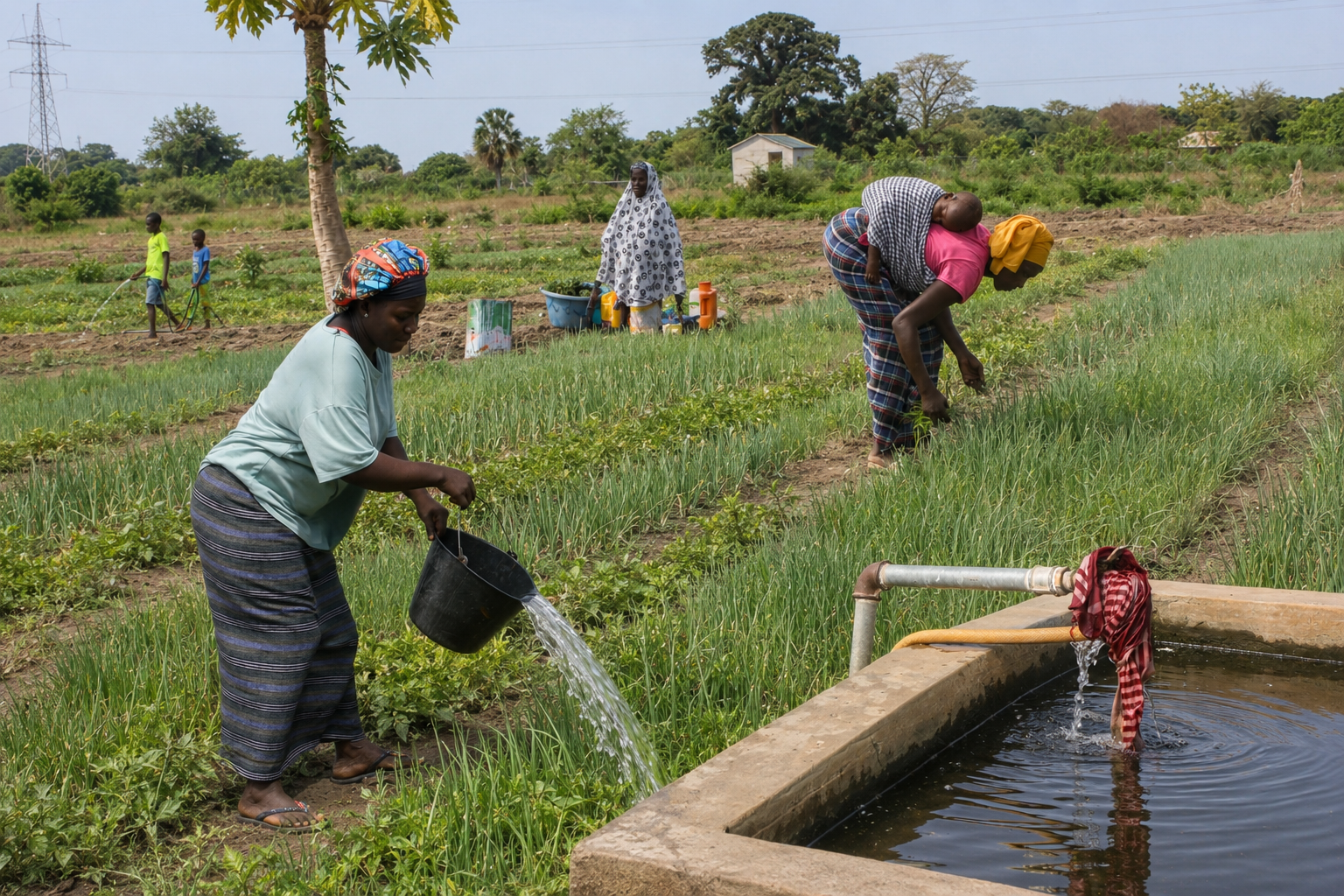
With watering cans in hand and hoes resting on their shoulders, women move from one vegetable bed to another, carefully watering seedlings, removing weeds, and inspecting leaves for signs of pests. By 6 a.m., their work is well underway.
For these women, gardening is far more than a daily routine. It is their lifeline.
The vegetables they grow—spring onions, okra, tomatoes, peppers and other fast-growing crops—not only feed their families but also provide the income they rely on to pay school fees, buy food, and meet household expenses.
While the rainy season signals the start of traditional farming of rice, maize, groundnuts and melons across many parts of The Gambia, it also marks the beginning of another important season in Batabut Kantora—the vegetable gardening season. For dozens of women in the community, these small plots of land represent opportunity, independence and hope.
This reporter visited the women gardeners in July 2026 to listen to their stories.
For five years, Binta Colley has nurtured both her crops and her dreams. As Vice President of the Batabut Kantora Women Gardeners Association, she has witnessed how gardening has transformed not only her own life but also the lives of many women in the village.
"Gardening has changed my life in many ways. It is through gardening that I pay my children's school fees and buy their books, uniforms and school bags," Colley said.
She explained that the income she earns from selling vegetables allows her to support her family without depending entirely on anyone else. Gardening, she said, has become the backbone of her household.
Yet behind every successful harvest lies a constant struggle.
Access to quality seeds remains one of the biggest challenges facing the women.
"We buy the seeds ourselves, or sometimes we ask neighbours who have them because we do not receive any support," she explained.
Water scarcity is another obstacle that limits production. During the dry months, the women often have to ration the little water available, forcing them to cultivate only small portions of their gardens.
Pests and crop diseases further threaten their livelihoods.
"The pests attack our crops, chew through the leaves and leave us with very little to harvest," Colley said.
Despite these setbacks, the women refuse to give up.
Every morning they return to the garden, working side by side to weed, water, transplant seedlings and harvest vegetables. Older women pass down farming knowledge to younger women and children, ensuring that the tradition continues for future generations.
For them, the garden is more than a place where food is grown. It is a symbol of resilience, dignity and women's empowerment. However, producing vegetables is only part of the challenge. Selling them is often just as difficult.
Colley stated that transporting produce to markets in Sibanor and Bwiam is both costly and unreliable. When transportation is unavailable, vegetables often go unsold and start to spoil before they reach customers.
"We struggle to find transport from here to Sibanor or Bwiam to sell our produce. When we cannot get a vehicle, we have to wait until the next day, and by then some of the vegetables have already spoiled. We are appealing to the authorities to help us with a storage facility so our produce can be kept fresh," she said.
She also noted that fluctuating market prices make it difficult for farmers to predict their earnings. While prices occasionally favour producers, they often fall below expectations, reducing profits after months of hard work.
Like Colley, many women in the community say gardening has strengthened their financial independence and given them a greater voice in household decision-making.
For Natoma Barrow, who has spent the past 15 years cultivating vegetables, the garden has provided opportunities she once thought impossible.
"Since I started gardening, I have bought a bed set, chairs and everything I need in my house without asking my husband," Barrow said.
She believes the women have the determination to expand their
production but lack the resources to do so.
"We need boreholes, sprinklers and farming equipment to make our work easier," she appealed.
Another gardener, Kaddy Jarju, said the benefits of gardening extend beyond income. It has improved her family's nutrition by providing fresh vegetables year-round.
"Gardening brings health benefits because we eat what we grow," Jarju said.
She added that growing vegetables at home has significantly reduced household food expenses, allowing her family to spend less on buying vegetables and other food items.
However, she said the quality of water remains a major concern.
"The water we use is salty, and it affects the productivity of our crops. We are appealing to the authorities to provide boreholes to reduce the problem," she said.
Despite the challenges they face, the women of Batabut Kantora remain optimistic. Their determination is evident in every seed they plant and every harvest they gather.
Their appeal is simple but urgent. They are calling on the government, development partners and other stakeholders to support them with boreholes, irrigation systems, farming tools, pest-control chemicals and storage facilities to improve production and reduce post-harvest losses.
As food prices continue to rise across The Gambia, the women gardeners of Batabut Kantora are proving that local solutions can have a powerful impact. Their gardens are doing more than producing vegetables—they are feeding families, creating economic opportunities, empowering women and strengthening food security, one harvest at a time.
Author: Fatou S. Sanyang
PC: Women Gardeners of Batabut Kantora
Comments (3)