
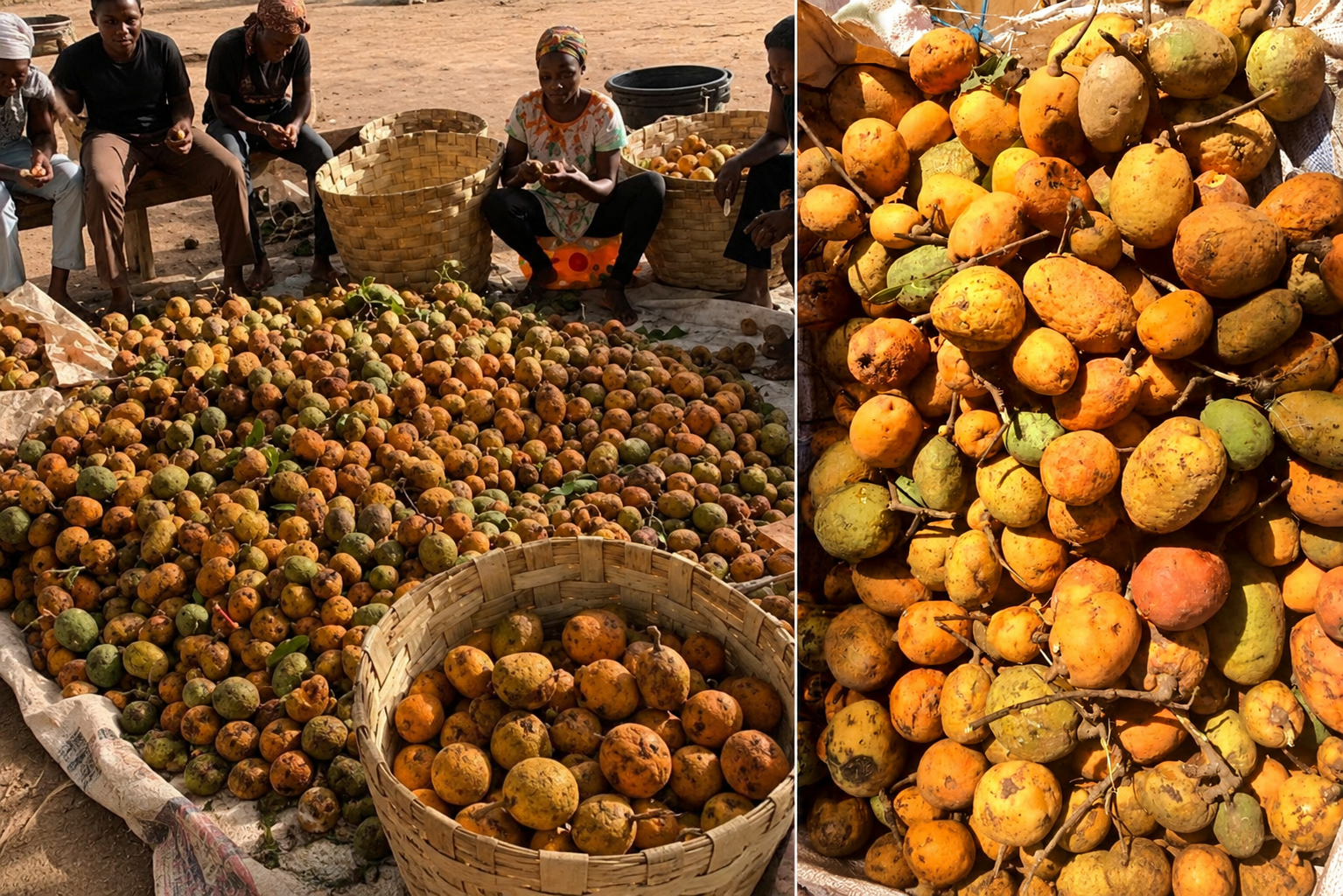
Its thick green-and-yellow skin conceals bright yellow pulp wrapped around large seeds. For many Gambians, slicing open a fresh Kaba instantly evokes childhood memories, family gatherings, and roadside stops. Some people sprinkle it with salt, sugar, pepper or seasoning cubes before eating it, while others transform the fruit into refreshing juice.
But beyond the fruit's popularity lies another story—one of resilience, entrepreneurship and survival. Across markets and roadsides, women are the driving force behind the kaba trade, turning a short-lived forest harvest into a source of income that sustains households throughout the rainy season.
In June 2026, this reporter looks at how Kaba keeps Gambian Families afloat during the rains. He met the women whose livelihoods depend on kaba to learn how they are transforming a seasonal wild fruit into an economic lifeline.
From Forest to Market
Before sunrise, the Brikama Sandika is already alive with activity. Women arrive as early as 5:00 a.m., eager to purchase sacks of freshly harvested kaba from rural suppliers before the day's trading begins. The market buzzes with negotiations as bags of fruit change hands, destined for roadside stalls and local markets across the country.
Among the wholesale traders is Yama Jarjue from Sohm Village in Kombo East District, where forests surrounding the community provide abundant kaba trees.
Every morning, her children venture deep into the forest to harvest the fruit.
"When they harvest them and bring them home, they sometimes fill four or five bags," Jarjue explained. "I then bring them to the Brikama Sandika to sell wholesale. The business was exceptionally lucrative initially because the fruit was scarce. Now, the price is a bit lower because more people have entered the business."
The work, however, comes with dangers.
Harvesters often climb tall trees where snakes hide among the branches, making every trip into the forest risky.
"They sometimes encounter snakes in the trees," she said. "They have to be very careful."
Despite the hazards, Jarjue says the business remains one of the most dependable sources of income for families in her village.
"In the rural areas, this is one of the main businesses we rely on during this season to generate income," she said. "Sometimes I sell each bag for 1,600 Dalasi, and sometimes a bit less. But at the end of the day, I return home with money to support my family."
Adding Value Through Innovation
Not far from the wholesale market, Fatou Camara has found a way to earn even more from the seasonal fruit. A widow who sells kaba at the Brikama Car Park, Camara, begins each day by purchasing fresh fruit from the Sandika before preparing part of her stock as juice.
"This business is very profitable for me because I don't just sell the raw fruit," she explained. "I also process some of it into kabaa juice. Many customers prefer it that way because they are afraid of accidentally swallowing the large seeds."
Rather than accepting the fruit's short three-month season, Camara has turned to experimentation.
Determined to extend her business beyond the rainy months, she has spent years testing different preservation methods using locally available resources.
"Kaba is seasonal; it lasts for about three months before disappearing from the market," she said.
"I have been researching local methods to preserve it longer. I tried boiling the fruit and refrigerating it for weeks to test its shelf life. Out of the many methods I tested, two worked well. Last year, I managed to preserve enough stock to stretch my selling season to six months."
Around her, other vendors attract customers by preparing freshly sliced kaba with customised combinations of pepper, sugar and salt, creating flavours that have become favourites among commuters and schoolchildren alike.
A Seasonal Safety Net
For Binta Colley from Omorto Village, kabaa is much more than a fruit. It is insurance against the financial hardships that often accompany the rainy season.
Every year, her children harvest kaba from forests near the Casamance border, and she then transports it to Brikama to sell.
"I use the money my children and I generate from this business to buy and store food commodities for the rainy season," Colley said. "I sell the fruits and use the proceeds to buy rice, cooking oil and other kitchen essentials."
She says the seasonal trade has kept food on her family's table for the past five years.
"Finding money during the rainy season is always difficult," she reflected. "But with this business, we ensure we have enough food in the house to pull us through."
More Than a Seasonal Fruit
For many Gambians, kaba is simply another fruit to enjoy during the rains. Yet behind every slice sold at a roadside stall is a network of women whose labour begins long before dawn—mothers negotiating wholesale prices, children harvesting fruit from forests, widows creating new products, and families relying on seasonal earnings to survive difficult months.
Their work demonstrates how traditional knowledge, natural resources and entrepreneurial spirit combine to support rural and urban livelihoods.
As the rains continue to fall and the kaba season reaches its peak, these women are doing more than selling fruit. They are preserving a uniquely Gambian tradition while proving that even a wild fruit growing deep in the forest can become a pathway to resilience, innovation and economic empowerment.
Author: Nelson Manneh
PC: Women preparing Kaba for sale
Comments (0)
No comments yet. Be the first to comment!