
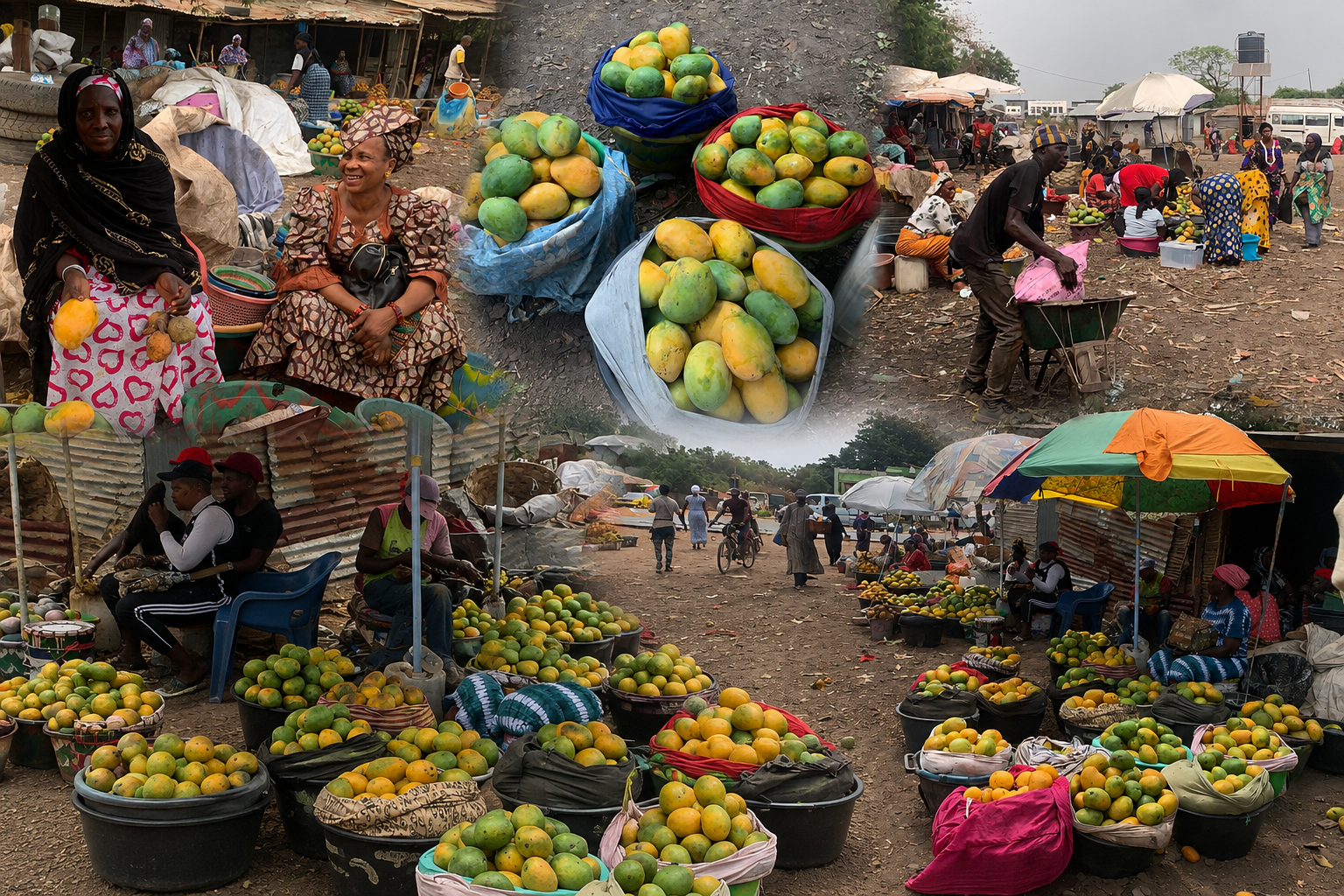
For decades, women have been at the heart of Brikama’s seasonal mango trade, transforming one of The Gambia’s most beloved fruits into a source of livelihood. From the sweet and popular Jurr to varieties such as Tandugu, Keitt or Ketto, Sierra Leone, and Lamen, these women know every type of mango that passes through the market. They carefully select, sort, and sell the fruits that customers eagerly wait for each season. Despite the challenges they face, they continue to rely on the trade that has supported their households, educated their children, and sustained their families for generations.
In June 2026, this medium visited women mango vendors to learn about their experiences and how the seasonal trade continues to shape their lives.
Among them is Maimuna Jawo, a vendor from Brikama Jamisa who has spent nearly 20 years selling mangoes at the market.
“I have been selling here since my children were young, and some of them are now married. I thank God, Alhamdulillah. When you are healthy, you have everything,” she said with a smile.
For Jawo, the mango season represents an opportunity to earn an income and provide for her family.
“When I sell mangoes, the little I earn is what I use to take care of my family. This is where I earn my living,” she explained.
Like many of the women at Sandikaa Market, Jawo has watched the mango trade become an important part of the local economy. Mangoes are one of The Gambia’s most popular seasonal fruits and are enjoyed in many different ways. They can be eaten fresh, blended into juices and smoothies, sliced, salted and dried for snacks, or processed into jams, chutneys, and other products. Rich in vitamins and nutrients, mangoes provide both nutritional and economic value to communities across the country.
However, vendors say this year’s season has not been as productive as previous years.
According to Jawo, the popular mango variety known as “Jurr” remains in high demand, but supplies have dropped significantly.
“This season, there are not as many mangoes compared to last year. There has been a decrease in production, and prices have increased,” she said.
The reduced supply has forced many traders to source mangoes from Casamance in neighbouring Senegal, increasing their operating costs.
“We work with farmers directly, but this season many farmers in the Gambia do not have enough mangoes. Most of the mangoes I sell now are from Casamance,” Jawo explained.
She added that transportation costs have become a major challenge, particularly because suppliers quote prices in CFA francs, making the fruits more expensive when converted to Gambian Dalasi. Another challenge facing the women is the lack of a permanent selling space.
For years, vendors have moved between the Brikama main garage and Sandikaa Market depending on the season and availability of space. Jawo believes a designated market area would make a significant difference to their businesses.
“We are tired of moving from the garage to Sandikaa. Sometimes when the authorities meet you selling, they throw away the things you are selling,” she said.
For Kaddy Sonko from Brikama Wellingara, who has spent more than five years in the mango business, the season remains one of the most important periods of the year.
“When mangoes are many, the market becomes slow, and I don’t earn much. But when they are fewer, I sell more,” Sonko said.
Although demand remains strong, she noted that the high cost of purchasing mangoes has reduced profit margins, making it increasingly difficult for traders to earn a decent income.
The women also suffer significant losses due to the lack of storage and preservation facilities. Mangoes are highly perishable, and once they ripen, vendors have only a limited window to sell them before they spoil. As a result, many are forced to slash prices or give away fruit that cannot be sold in time.
For Binta Kebbeh from Brikama, Gidda Baba Njie, who has been selling mangoes for 28 years, such losses can be painful.
“You can buy a basket for D800 and later sell it for D600, or buy it for D700 and sell it for D400. That is a huge loss because we do not have anywhere to store them,” she said.
Yet despite the setbacks, Kebbeh says the business has changed her life.
“I thank God for my mango business. It has helped me. I was able to buy a compound and build a house for myself,” she said proudly.
Her story reflects the experiences of many women at the market who have used earnings from seasonal fruit trading to improve their lives and support their families.
For Hawa Sanneh of Brikama Misirah, who has spent 12 years selling seasonal fruits, one solution lies in creating opportunities for value addition.
She believes The Gambia could benefit greatly from a mango processing factory that would transform excess fruit into products such as juice, jam, concentrates, and dried mangoes.
“If we have a mango factory here in The Gambia, it will be very helpful because unsold mangoes can be processed into juice instead of being wasted,” Sanneh said.
According to her, such an investment would reduce waste, create jobs, and provide a more stable market for farmers and traders alike.
She also called for improvements to Sandikaa Market, including better facilities and stronger support for women vendors who depend on seasonal trading for their livelihoods.
Despite the difficulties, the women remain optimistic. Every basket of mangoes sold represents an opportunity to earn a living, educate a child, or provide a meal for a family.
For the women keeping Brikama’s seasonal mango trade alive, the fruit is far more than a source of refreshment during the rainy season. It is a symbol of resilience, hard work, and hope.
As customers browse through piles of yellow and green mangoes at Sandikaa Market, few may realize the stories behind each basket. But for the women who sell them, the message is simple and powerful.
Author: Kaddy Sowe & Fatou S. Sanyang
Comments (1)