
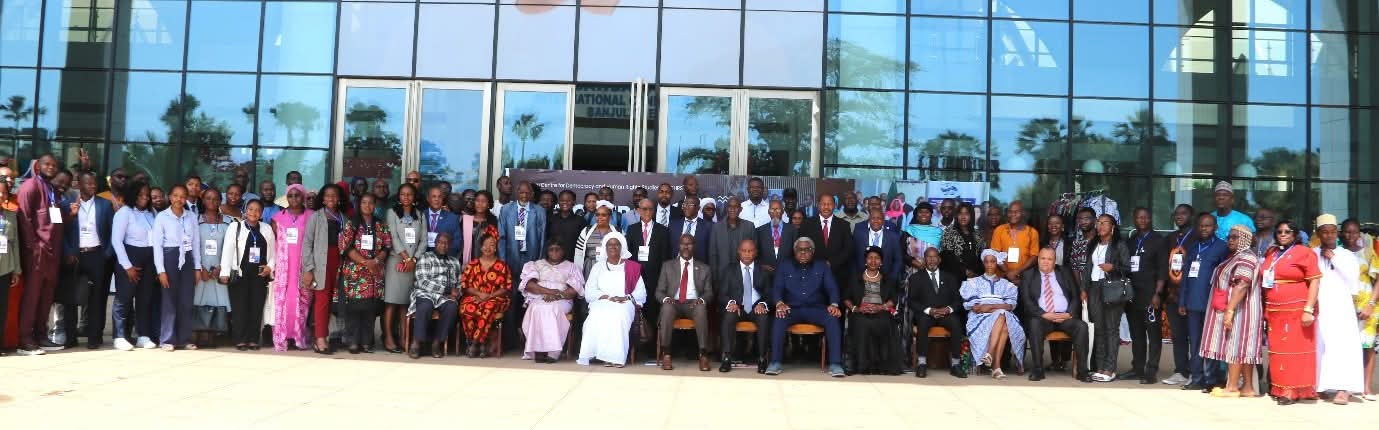
The Forum on the Participation of NGOs took place from October 17 to 19, 2025, under the theme “Justice for Africans and People of African Descent Through Reparations.” It brought together civil society organisations (CSOs), NGOs, state parties, commissioners, and individual human rights defenders to address pressing human rights issues affecting the continent, make recommendations, and adopt resolutions to be presented to the African Commission during its session.
At the Forum, Commissioner Remy Ngoy Lumbu called for the inclusion of individual participants in future editions to ensure that those most affected by human rights issues have a platform to express themselves.
Commissioner Lumbu emphasised that while the Forum has served as an important space for NGOs, it should also welcome individuals who often face repression and lack avenues to share their experiences.
He described reparations as a matter of both historical and moral significance, stating that they go beyond financial compensation to include acknowledgement, rehabilitation, and guarantees of non-repetition.
He urged participants and the African Commission on Human and Peoples' Rights to take action on these crucial issues to ensure the Forum remains responsive to the lived experiences of Africans and people of African descent, the ultimate beneficiaries of the human rights system.
Commissioner Lumbu reaffirmed the African Commission on Human and Peoples’ Rights' (ACHPR) commitment to ensuring that African voices, especially those of victims and marginalised individuals, are heard and respected in discussions about human rights on the continent.
Delivering a statement on behalf of the Honourable Attorney General and Minister of Justice of The Gambia, Mr Hussien Thomasi, the Solicitor General and Legal Secretary praised the NGO Forum for its ongoing efforts to promote human rights dialogue in Africa.
Thomasi described the human rights landscape in Africa as a mixture of significant progress and ongoing challenges. He noted that many African nations have ratified key human rights treaties and strengthened their domestic legal frameworks to align with international standards. However, he warned that issues such as armed conflict, forced displacement, restrictions on civic space, and impunity for violations continue to undermine these achievements.
“In many countries governed by military regimes or dominant single-party systems, freedoms of expression, assembly, and association are severely restricted. Journalists and human rights defenders face arbitrary arrest, detention, and intimidation,” he stated.
The Solicitor General also emphasised the essential role of National Human Rights Institutions (NHRIs) and civil society organisations in monitoring compliance, advocating for reforms, and raising awareness. He said these entities are crucial in promoting accountability and ensuring that the principles of equality and justice are upheld at both national and regional levels.
Madam Corlette Letlojane, a member of the NGO Steering Committee, emphasised that the African Union (AU) views reparations as a call to action for the international community. She encouraged a collective effort to rectify historical wrongs and foster a future where justice and equality are realities for all people of African descent. Her statement highlighted that this initiative aims not only to address past grievances but also to pave the way for a more equitable and inclusive future.
Letlojane emphasised the importance of recognising both historical and contemporary issues, asserting that the AU initiative seeks to inspire global cooperation and concerted efforts to bring about meaningful change. This ensures that the rights and dignity of Africans and people of African descent are upheld and respected worldwide.
She noted that one of the challenges facing the continent is post-colonisation, particularly black-on-black violence. “We need to emphasise the founding principles of solidarity, unity, cohesion, and integration within the African continent,” she stated.
Additionally, she highlighted that discrimination and deportation are significant challenges for Africans and people of African descent. “We have seen the trauma our people endure in our countries. This exacerbates challenges and undermines the very theme adopted by the AU, diminishing their dignity and rights as individuals.”
Letlojane called for the naming and shaming of countries that have received deported individuals from the United States, including Eswatini, South Sudan, Rwanda, and Ghana. “We urge the AU to encourage member states to terminate those agreements and facilitate the return of deportees to the African continent,” she concluded.
Madam Yvonne Fungai Tawanda Masarakufa, a Human Rights Adviser at the Office of the United Nations Resident Coordinator in The Gambia, has reaffirmed the United Nations' strong partnership with African civil society and human rights defenders in promoting reparatory justice and inclusive governance.
Representing the Office of the UN High Commissioner for Human Rights (OHCHR), Madam Masarakufa stated that reparatory justice is "not only about the past; it is about reimagining today’s systems to ensure that future generations inherit dignity and not discrimination."
She emphasised the crucial role of NGOs in documenting human rights violations, amplifying the voices of victims, and holding institutions accountable. "Your independence, closeness to communities, and ability to build coalitions make you essential architects of people-centred solutions," she noted.
Furthermore, Masarakufa highlighted frameworks like the Durban Declaration and the African Union Transitional Justice Policy as strong foundations for reparations and systemic redress. She called for closer alignment between national, regional, and UN efforts.
She announced a series of joint activities between the ACDHRS and OHCHR, which will include panels on protecting human rights defenders, capacity-building on international human rights mechanisms, and the launch of a UN report on enforced disappearances.
In conclusion, she reaffirmed the OHCHR’s threefold commitment to continuing close collaboration with civil society and ACDHRS, advocating for a safe and conducive environment for human rights defenders, and ensuring that recommendations are translated into measurable, time-bound actions. “Together, we can build a future anchored in dignity, justice, and the full realisation of human rights for all,” she affirmed.
Author: Halimatou Ceesay
Comments (0)
No comments yet. Be the first to comment!